

How Many Ml In Pint
| Pint | |
|---|---|
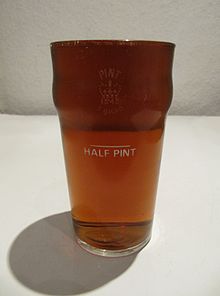 A total pint glass. The fill up line indicates a half pint. | |
| General information | |
| Unit of | book |
| Symbol | pt or p |
| Conversions (imperial) | |
| 1 imp pt in ... | ... is equal to ... |
| SI derived unit of measurement | 568.26125 mL |
| Conversions (US) | |
| 1 US pt in ... | ... is equal to ... |
| SI derived unit | 473.176473 mL (liquid) |
| SI derived unit of measurement | 550.610471 mL (dry) |
The pint (,  heed(assistance·info) ; symbol pt,[ane] [2] sometimes abbreviated as p [3]) is a unit of measurement of volume or capacity in both the imperial and United States customary measurement systems. In both of those systems it is traditionally one eighth of a gallon. The British regal pint is virtually xx% larger than the American pint because the 2 systems are defined differently. Nigh all other countries accept standardized on the metric organization, then although some of them still also accept traditional units called pints (such equally for beverages), the book varies by regional custom.
The regal pint (≈ 568 mL) is used in the Britain and Ireland and to a express extent in Democracy nations. In the United States, 2 kinds of pint are used: a liquid pint (≈ 473 mL) and a less-common dry pint (≈ 551 mL). All of the other former British colonies, such as Canada, Australia, South Africa and New Zealand, converted to the metric system in the 1960s and 1970s; so, while the term pint may still be in common use in these countries, information technology may no longer refer to the British regal pint once used throughout the British Empire.
Since the majority of countries in the globe no longer utilize American or British purple units, and near are non-English speaking, a "pint of beer" served in a tavern outside the United kingdom and the U.s.a. may exist measured by other standards. In Republic countries it may be a British imperial pint of 568 mL, in countries serving big numbers of American tourists it might be a US liquid pint of 473 mL, in many metric countries it is a half-litre of 500 mL, or in some places it is another measure reflecting national and local laws and customs.[4]
Name [edit]
Pint comes from the Old French word pinte and perhaps ultimately from Vulgar Latin pincta meaning "painted", for marks painted on the side of a container to show capacity.[5] It is linguistically related, though profoundly diverging in meaning, to Pinto – an Italian, Spanish, and Portuguese name for a person with a speckled or night complexion, oftentimes used equally a surname in these languages.
Definitions [edit]
Regal pint [edit]
- The majestic pint is equal to one eighth of an purple gallon.

Imperial pint cans (568 mL) commonly institute in British supermarkets
-
-
1 imperial pint = 1⁄eight regal gallon = 1⁄two royal quart = 4 imperial gills = xx royal fluid ounces = 568.26125 millilitres (exactly)[a] [6] ≈ 34.677429099 cubic inches[b] ≈ 1.2009499255 US liquid pints ≈ 1.0320567435 US dry pints ≈ nineteen.21519881 US fluid ounces ≈ the volume of 20 oz (567 g) of water at 62 °F (sixteen.7 °C)
-
US liquid pint [edit]
In the United States, the liquid pint is legally divers every bit one 8th of a liquid gallon of precisely 231 cubic inches.
-
-
one US liquid pint = 1⁄8 United states of america liquid gallon = 1⁄ii Us liquid quart = 2 Us cups = 4 United states of america fluid gills = 16 US fluid ounces = 32 United states of america tablespoons = 96 United states of america teaspoons = 128 US fluid drams = 28.875 cubic inches (exactly)[b] = 473.176473 millilitres (exactly)[c] ≈ 0.83267418463 imperial pints ≈ 0.85936700738 Us dry pints ≈ 16.65348369 imperial fluid ounces ≈ the book of i.041 lb (472 g) of water at 62 °F (16.7 °C)
-
United states dry pint [edit]
In the Usa, the dry pint is i sixty-fourth of a bushel.
-
-
1 US dry pint = 0.015625 U.s. bushels = 0.0625 US pecks = 0.125 US dry gallons = 0.5 The states dry quarts = 33.6003125 cubic inches = 550.6104713575 millilitres[c] ≈ 0.96893897192092 imperial pints ≈ ane.1636471861472 US pints
-
Other pints [edit]

Blueberries labelled in English (1 United states Dry out PINT) and French (1 CHOPINE SÈCHE Us 551 mL) for sale in the Usa and Canada
| Blazon | Definition | Equals | Annotate |
|---|---|---|---|
| Flemish pintje | 250 mL | ||
| India | 330 mL | 330 mL | 'Pint canteen' capacity. |
| Southward Australian pint | 425 mL | 425 mL | Known in the rest of Australia equally a schooner |
| US liquid pint | 16 The states fl oz | ≈ 473 mL | Used in the Usa. |
| The states dry pint | xviii.6 US fl oz | ≈ 551 mL | Less common. |
| Majestic pint | twenty imp fl oz | ≈ 568 mL | Used in the UK and Republic of ireland. |
| Australian pint | 570 mL | 570 mL | Based on the imperial pint rounded to a metric value. |
| Majestic pint or pinte du roi | 48 French cubic inches | ≈ 952 mL | Varied past region from 0.95 to over two litres. |
| Canadian pinte de bière | Majestic quart | ≈ 1136 mL | |
| Scottish pint or joug (obsolete) | 2 pints and 19.69 imp fl oz | ≈ 1696 mL |
The United States dry out pint is equal to one 8th of a The states dry gallon. It is used in the United States, but is not every bit common equally the liquid pint.
A now-obsolete unit of measurement of measurement in Scotland, known as the Scottish pint, or joug, is equal to 1696 mL (2 pints 19.69 imp fl oz). It remained in use until the 19th century, surviving significantly longer than most of the old Scottish measurements.
The word pint is one of numerous fake friends betwixt English and French. They are non the same unit although they have the same linguistic origin. The French give-and-take pinte is etymologically related, but historically described a larger unit. The Regal pint (pinte du roi) was 48 French cubic inches (952.1 mL),[vii] simply regional pints varied in size depending on locality and on article (usually wine or olive oil) varying from 0.95 L to over 2 50.[7]
In Canada, the Weights and Measures Act (R.S. 1985) defines a pint in English language as 1/viii of a gallon, just defines a pinte in French as i/4 of a gallon.[8] Thus, if you speak English and order "a pint of beer", servers are legally required to serve you 568 mL of beer,[9] only if you speak French and order "une pinte de bière", they are legally required to serve an royal quart (une pinte), which is 1136 mL, or twice every bit much.[10] To order an purple pint when speaking French in Canada, one must instead order une chopine de bière.[11]
In Flemish region, the word pintje, meaning 'niggling pint', refers only to a 250 mL drinking glass of lager. Some West- and East-Flemish dialects utilize it every bit a discussion for beaker. The equivalent discussion in German, Pintchen, refers to a glass of a third of a litre in Cologne and the Rhineland.
In Due south Australia, ordering "a pint of beer" results in 425 mL (15 fl oz) being served. Customers must specifically asking "an Imperial pint of beer" to get 570 mL (twenty fl oz). Australians from other states often contest the size of their beers in Adelaide.[12]
Equivalence [edit]
One U.s. liquid pint of water weighs 1.04318 pounds (16.6909 oz), which gives rise to a pop saying: "A pint's a pound, the world around".[xiii]
However, the statement does not hold effectually the world because the British imperial pint, which was as well the standard measure in Australia, Republic of india, Malaya, New Zealand, South Africa and other former British colonies, weighs i.2528 pounds (20.0448 oz), giving rise to the origin of a popular saying used in Republic countries: "a pint of pure water weighs a pound and a quarter".[14]
History [edit]
The pint is traditionally one 8th of a gallon. In the Latin of the apothecaries' system, the symbol O ( octavius or octarius ; plural octavii or octarii – reflecting the "8th" concept in its octa- syllable) was used for the pint.[15] Considering of the multifariousness of definitions of a gallon, there have been equally many versions of the pint.
Britain's North American colonies adopted the British wine gallon, defined in 1707 as 231 cubic inches exactly (three in × seven in × 11 in) as their basic liquid measure, from which the U.s. wet pint is derived; and the British corn gallon ( 1⁄viii of a standard "Winchester" bushel of corn, or 268.viii cubic inches) as its dry mensurate, from which the US dry pint is derived.
In 1824, the British parliament replaced all the various gallons with a new royal gallon based on ten pounds of distilled water at 62 °F (16.667 °C) (277.42 cubic inches), from which the current UK pint is derived.
The various Canadian provinces continued to employ the Queen Anne Winchester wine gallon as a basis for their pint until 1873, well later Britain adopted the imperial system in 1824. This made the Canadian pint compatible with the American pint, merely afterward 1824 information technology was incompatible with the British pint. The traditional French pinte used in Lower Canada (Quebec) was twice the size of the traditional English "pint" used in Upper Canada (Ontario), well-nigh one litre versus 0.5 litres. After four of the British provinces united in the Canadian Confederation in 1867, Canada legally adopted the British purple system of measure in 1873, making Canadian liquid units incompatible with American ones from that year frontward.[sixteen] In 1873, the French Canadian pinte was defined as being one imperial quart or two imperial pints, while the imperial pint was legally chosen a chopine in French Canada. Canadian imperial units of liquid measure remain incompatible with American traditional units to this day, and although the Canadian pint, quart, and gallon are nevertheless legal units of measure in Canada, they are still 20% larger than the American ones.
Historically, units called a pint (or the equivalent in the local language) were used beyond much of Europe, with values varying between countries from less than half a litre to over ane litre. Inside continental Europe, these pints were replaced with liquid measures based on the metric arrangement during the 19th century. The term is nevertheless in express use in parts of France, where une pinte means an regal quart, which is 2 regal pints, whereas a pint is une chopine —and Central Europe, notably some areas of Germany[17] and Switzerland, where ein Schoppen is colloquially used for roughly half a litre. In Spanish holiday resorts frequented by British tourists, 'pint' is often taken to mean a beer glass (especially a dimple mug). Half-pint 285 mL, and pint mugs , 570 mL, may therefore be referred to as media jarra ('half jar/jug') and jarra (grande) ('large jar/jug').[ citation needed ]
Furnishings of metrication [edit]

Pints are commonly used for the sale of milk in the United Kingdom. The label gives both the metric and the regal volume.
In the British and Irish metrication processes, the pint was replaced by metric units as the legally defined primary unit of measure for trading by volume or capacity, except for the sale of draught beer and cider, and milk in returnable containers.[eighteen] [19] The pint for these specific purposes is considered to be 568.3 mL in EU directive fourscore/181/EER.[20] As a supplementary unit, the pint can withal be used in those countries in all circumstances. U.k. legislation mandates that draught beer and cider must exist sold in a third of a pint, two thirds of a pint or multiples of one-half a pint, which must be served in stamped, measured glasses or from authorities-stamped meters. For milk, if returnable containers are used, the pint can nevertheless be the principal unit used, however all other goods sold past volume must be sold by metric. Milk in returnable containers is considered a loose skilful instead of a packaged good, as information technology is sold by volume. Milk in plastic containers come in 1 pint sizes, but are required to display the metric equivalent on packaging.[21] Recipes published in the Great britain and Ireland will have given ingredient quantities in imperial, where the pint is used as a unit for larger liquid quantities, as well as the metric measure - though recipes written now are more likely to utilise metric units.[22] [23]
In Australia and New Zealand, a subtle change was fabricated to one-pint milk bottles during the conversion from majestic to metric in the 1970s. The pinnacle and diameter of the milk bottle remained unchanged, and then that existing equipment for handling and storing the bottles was unaffected, but the shape was adapted to increment the capacity from 568 mL to 600 mL—a conveniently rounded metric measure. Such milk bottles are no longer officially referred to as pints. All the same, the "pint glass" in pubs in Australia remains closer to the standard regal pint, at 570 mL. Information technology holds almost 500 mL of beer and about 70 mL of froth, except in South Australia, where a pint is served in a 425 mL drinking glass and a 570 mL drinking glass is called an "regal pint". In New Zealand, there is no longer any legal requirement for beer to be served in standard measures: in pubs, the largest size of glass, which is referred to equally a pint, varies, but usually contains 425 mL.[24]
After metrication in Canada, companies sold milk and other liquids in metric units so conversion bug could no longer arise. Draft beer in Canada, when advertised equally a "pint", is legally required to exist 568 mL (xx fluid ounces).[25] [26] With the immune margin of mistake of 0.five fluid ounces, a "pint" that is less than 554 mL of beer is an offence, though this regulation is often violated and rarely enforced.[27] To avoid legal issues, many drinking establishments are moving away from using the term "pint" and are selling "glasses" or "sleeves" of beer, neither of which have a legal definition.[28]
A 375 mL bottle of liquor in the US and the Canadian maritime provinces is sometimes referred to as a "pint" and a 200 mL bottle is called a "half-pint", harking back to the days when liquor came in US pints, fifths, quarts, and half-gallons.[29] Liquor in the United states of america has been sold in metric-sized bottles since 1980 although beer is notwithstanding sold in United states of america traditional units.[30]
In France, a standard 250 mL measure out of beer is known as united nations demi ("a half"), originally meaning a one-half-pint.
Notes [edit]
- ^ Afterwards the 1985 (UK), c. 1964 (Canada), redefinition of the imperial gallon
- ^ a b Fifty imperial pints, or threescore US liquid pints, are both very close to 1 cubic foot
- ^ a b After the 1964 redefinition of the litre and the 1959 redefinition of the inch
References [edit]
- ^ IEEE SA - 260.1-2004 - IEEE Standard Letter Symbols for Units of Measurement one Pint is 1 cup (SI Units, Customary Inch-Pound Units, and Certain Other Units). IEEE. 2010. Archived from the original on 26 December 2018. Retrieved ten June 2017.
- ^ BS 350:Role 1:1974 Conversion factors and tables - Office 1. Basis of tables Conversion factors. British Standards Institution. 1974. pp. 10–11.
- ^ "Definition of P". www.merriam-webster.com . Retrieved 29 May 2017.
- ^ American Journal of Physics, v.67(1), 1999-January, p.13-xvi, Romer,R.H.; Editorial: Units: SI only, or multi-cultural diversity?
- ^ "Pint". Merriam-Webster.com. 2013. Retrieved 31 May 2013.
- ^ Text of the Units of Measurement Regulations 1995 (Schedule) as originally enacted or made inside the United Kingdom, from legislation.gov.united kingdom of great britain and northern ireland.
- ^ a b Palaiseau, JFG (October 1816). Métrologie universelle, ancienne et moderne: ou rapport des poids et mesures des empires, royaumes, duchés et principautés des quatre parties du monde. Bordeaux. p. eight. Retrieved thirty October 2011.
- ^ "Weights and Measures Act (R.S. 1985)" (PDF).
- ^ "Pints of draft beer". Measurement Canada. Retrieved 2016-09-xviii .
- ^ The site Measurement Canada contains a wealth of documentation on official Canadian measurements. The French linguistic communication version of the site is Mesures Canada.
- ^ "Chopines de bière pression". Mesures Canada. Retrieved 2016-09-18 .
- ^ Keane, Daniel (September 8, 2017). "Getting to the bottom of the pint: the bitter problem of Adelaide's beer glasses". ABC News. Adelaide. Retrieved September nine, 2017.
- ^ "A Pint'due south a Pound the Earth Around". Government Volume Talk (blog). U.S. Authorities Publishing Part. 2010-04-27. Retrieved 2017-01-thirty .
- ^ Penny Cyclopaedia of the Society for the Diffusion of Useful Knowledge. C. Knight. 1843. pp. 200.
- ^ British Pharmacopoeia, 1864. 1916. Retrieved 2016-09-22 .
- ^ Ross, Lester A. (1983), Archeological Metrology: English, French, American and Canadian systems of Weights and Measures for North American Historical Archeology (PDF), Government of Canada, retrieved 10 November 2014
- ^ Duden, February 28, 2016.
- ^ Weights and measures, Business concern Link (Section for Concern, Innovation and Skills), archived from the original on 23 Baronial 2012, retrieved 12 November 2011
- ^ "Weights and Measures". British Beer and Pub Association. Retrieved 10 January 2015.
- ^ "Consolidated TEXT: 31980L0181 — EN — xiii.06.2020".
- ^ "Weights and Measures Human activity 1985".
{{cite web}}: CS1 maint: url-status (link) - ^ The Blistering Pocket Bible, Amy Lane, "Most UK recipes are now written in metric units but some recipes passed downward through families or in older recipe books may be written using imperial measurements".
- ^ Skills in Food Technology, Jenny Ridgwell, "If you are using old recipe books to help with inquiry for food ideas, yous volition find that the ingredients are given in Purple measures."
- ^ "Is a pint really a pint in Wellington?, 6 Sept 2012, The Dominion
- ^ Weights and Measures Act, Government of Canada, 1985, retrieved November 8, 2014
- ^ "Fairness at the Pumps Act". Industry Canada. Archived from the original on 24 September 2014. Retrieved 22 September 2014.
- ^ "We Need a Full Pint". Toronto Star. Retrieved 22 September 2014.
- ^ More than half of Vancouver confined aren't pouring real pints, National Post, July xviii, 2014, retrieved Nov 2, 2014
- ^ Elizabeth E. Epstein, Barbara S. McCrady (2009). Overcoming Alcohol Utilise Problems: A Cognitive-Behavioral Handling Program . Oxford University Press. p. 7.
- ^ United states of america CFR Title 27, Part 5, Subpart Eastward, Section five.47a
External links [edit]

Await upwards pint in Wiktionary, the costless dictionary.

Wikimedia Eatables has media related to Pint.
- European Commission press release (IP/07/1297, 11 September 2007): Pints and miles will non disappear due to European Committee proposal

How Many Ml In Pint,
Source: https://en.wikipedia.org/wiki/Pint
Posted by: arredondointoommand.blogspot.com
0 Response to "How Many Ml In Pint"
Post a Comment