

Alternative Form Of The Derivative
Definition of the Derivative
The Slope of a Secant Line
Instance:
Consider the function
y = f(ten) = ten2
And then the secant line from x = ii to x = four is defined past the the line that joins the ii points (ii,f(2)) and (iv,f(4)). This line has slope
f(iv) - f(ii) sixteen - 4
rise/run = = = half dozen
4 - 2 4 - 2
In general, we give the following definition
Allow y = f(10) exist a function. And so the gradient of the secant line between x = a and 10 = b is
f(b) - f(a)
b - a
The Derivative
If instead of choosing (4,f(4)), we choose (2 + h,f(ii + h)) every bit our second betoken nosotros have that the slope of the secant line is
f(2 + h) - f(2) f(2 + h) - f(2) =
(2 + h) - 2 h
(2 + h)2 - ii2 four + 4h + htwo - 4
= =
h h
4h + h2
= = 4 + h
h
What happens when we let h arroyo 0? Geometrically this is called the slope of the tangent line to f(x) at x = 2. Analytically, this is called the Derivative of f(x) at x = 2. For the above example, the limit is four. We say that f '(2) = iv.
Definition of the Derivative
The Derivative ( f '(10) or df /dx ) of f(ten) at x = c is defined past

Exercises: Find f ' of the following functions
A. f(x) = 2x - 1 at x = two
B. f(ten) = x2 at x = i
C.f(x) = one/ten at x = 3
D. f(10) =  at x = iv
We telephone call the function that takes an ten - value to the derivative at the x value the derivative of the function.
Example
Detect the derivative of
3
f(ten) =
10
Solution
We discover the limit
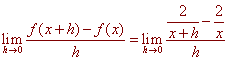
Now multiply by the numerator and denominator past x(ten + h) to get
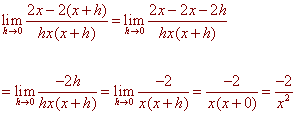
Exercises: Observe f '(ten) for the post-obit functions
A. f(x) = x3
B.f(x) = iv - ten
C.f(10) = 
Alternate Form of the Derivative
There is some other way to write the derivative. Since the derivative is the limiting slope of the secant line, we can retrieve as the first point at c be stock-still and and so second indicate exist a varying value x that tend towards c. Then the slope of the tangent line will be
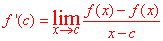
If a role is not continuous then the numerator will either not exist or volition non arroyo nix, while the denominator will arroyo zero. This leads us to the following theorem.
Theorem
If f(10) is a differentiable function at ten = c and so f(x) is continuous at 10 = c .
The antipodal of this theorem is non always true. That is there are continuous functions that are not differentiable. For case, let
f(ten) = | x |
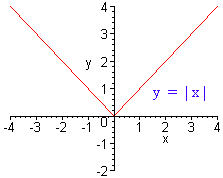
From the graph, we can see that the slope of the secant line will exist -1 to the left of 0 and 1 to the right of 0. At the origin the derivative is undefined fifty-fifty though f(x) is continuous at the origin.
When is a function differentiable?
Reply: When it is continuous, has no sharp edges, and the tangent line is not vertical.
Dorsum to the calculus home page
Back to the math department home folio
eastward-mail Questions and Suggestions

Alternative Form Of The Derivative,
Source: https://ltcconline.net/greenl/courses/115/differentiation/derdef.htm
Posted by: arredondointoommand.blogspot.com
0 Response to "Alternative Form Of The Derivative"
Post a Comment