

Do Telescoping Series Always Converge
To determine whether a series is telescoping, nosotros'll need to summate at to the lowest degree the first few terms to see whether the heart terms start canceling with each other.
Convergence of the telescoping serial
To see whether or not a telescoping serial converges or diverges, nosotros'll need to look at its serial of partial sums ???s_n???, which is but the sum of the serial through the commencement ???n??? terms.
???s_n=\sum_{i=1}^due north a_i=a_1+a_2+...+a_n???
Looking at this equation for ???s_n???, we tin can imagine that the sum of the series through the first four terms would be the fractional sum ???s_4???, or
???s_4=\sum_{i=i}^iv a_i=a_1+a_2+a_3+a_4???
???s_4=a_1+a_2+a_3+a_4???
What we want to effigy out is whether or non we'll get a real-number respond when we have the sum of the unabridged series, because if nosotros take the sum of the entire series and we go a real-number answer, this means that the series converges. Otherwise, if the sum of the entire series turns out to exist space, that means the series diverges. In other words, nosotros desire to become a real-number respond ???due south???, when we use an space number of terms ???n??? in the series of partial sums ???s_n???. ???s??? is the sum of the series, where
???s=\lim_{n\to\infty}s_n=\sum_{n=i}^\infty a_n=a_1+a_2+a_3+...+a_n???
So if we calculate the limit as ???n\to\infty??? of ???s_n??? and nosotros get a real-number respond ???southward???, and so we can say that the series of partial sums ???s_n??? converges, and this lets us also conclude that the serial ???a_n??? converges. If nosotros cannot find a real-number answer for ???s???, then ???s_n??? diverges, and therefore ???a_n??? also diverges.
To discover ???s_n???, we'll aggrandize the telescoping series by calculating the beginning few terms, making sure to likewise include the last term of the serial, then simplify the sum past canceling all of the terms in the middle. The remaining series will be the series of fractional sums ???s_n???.
Say whether the telescoping series converges or diverges
Case
Show that the series is a telescoping series, then say whether the series converges or diverges.
???\sum^{\infty}_{n=1}\frac{1}{n}-\frac{1}{n+1}???
In order to bear witness that the serial is telescoping, we'll need to kickoff by expanding the serial. Let'southward use ???n=1???, ???n=2???, ???n=3??? and ???north=4???.
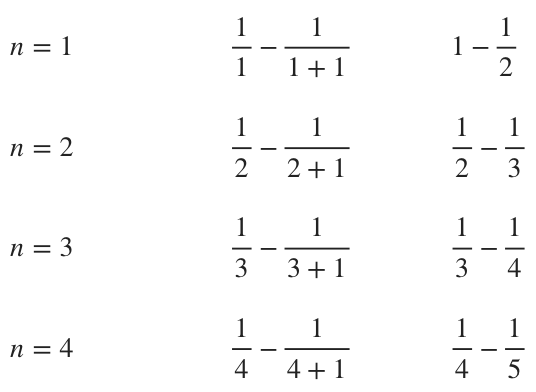
Writing these terms into our expanded serial and including the concluding term of the series, we get
???s=\lim_{n\to\infty}s_n=\sum^{\infty}_{northward=ane}\frac{1}{n}-\frac{ane}{northward+1}???
???=\lim_{n\to\infty}\left[\left(1-\frac{i}{ii}\right)+\left(\frac{ane}{2}-\frac{1}{three}\correct)+\left(\frac{i}{three}-\frac{ane}{4}\right)+\left(\frac{i}{four}-\frac{1}{5}\correct)+...+\left(\frac{1}{n}-\frac{one}{n+1}\right)\correct]???
The serial is telescoping if we can cancel all of the terms in the middle (every term but the first and last). When nosotros look at our expanded series, nosotros see that the 2d half of the first term volition cancel with the offset half of the second term, that the second half of the second term will cancel with the kickoff half of the third term, and then on, and then nosotros can say that the series is telescoping.

The series is telescoping if nosotros can cancel all of the terms in the heart (every term just the get-go and concluding).
Canceling everything but the first half of the first term and the second one-half of the terminal term gives an expression for the series of partial sums.
???southward=\lim_{n\to\infty}s_n=\lim_{n\to\infty}ane-\frac{1}{n+ane}???
If this serial of partial sums ???s_n??? converges as ???northward\to\infty??? (if we get a real-number value for ???s???), then we can say that the series of partial sums converges, which allows us to conclude that the telescoping series ???a_n??? as well converges.
???s=\lim_{north\to\infty}1-\frac{1}{n+i}???
???s=\lim_{n\to\infty}1-\frac{\frac{1}{due north}}{\frac{due north}{n}+\frac{1}{due north}}???
???s=\lim_{n\to\infty}one-\frac{\frac{1}{northward}}{1+\frac{1}{n}}???
???southward=i-\frac{0}{1+0}???
???s=1-0???
???s=one???
Since ???due south??? exists as a real number, the sum of the series is ???s=i???, and we can conclude that the series of fractional sums ???s_n??? converges, and therefore that the serial ???a_n??? as well converges.

Get access to the complete Calculus two course

Do Telescoping Series Always Converge,
Source: https://www.kristakingmath.com/blog/convergence-of-a-telescoping-series
Posted by: arredondointoommand.blogspot.com
0 Response to "Do Telescoping Series Always Converge"
Post a Comment